
Legacy Asset Locator — Give Your Family a Map, Not a Mess
If you were in a hospital bed tomorrow, would the people you love actually know what exists, where it is, and how to begin — or would they be searching blind?
Most families have one person who knows where everything is. When that person is suddenly unavailable — through illness, accident, or death — everyone else is left guessing.

Give them a map, not a mess.
The Legacy Asset Locator is a preparedness tool built to solve this very problem. It guides you through six logical categories to build your map — so the people you've appointed have everything they need, without you handing over a single password.
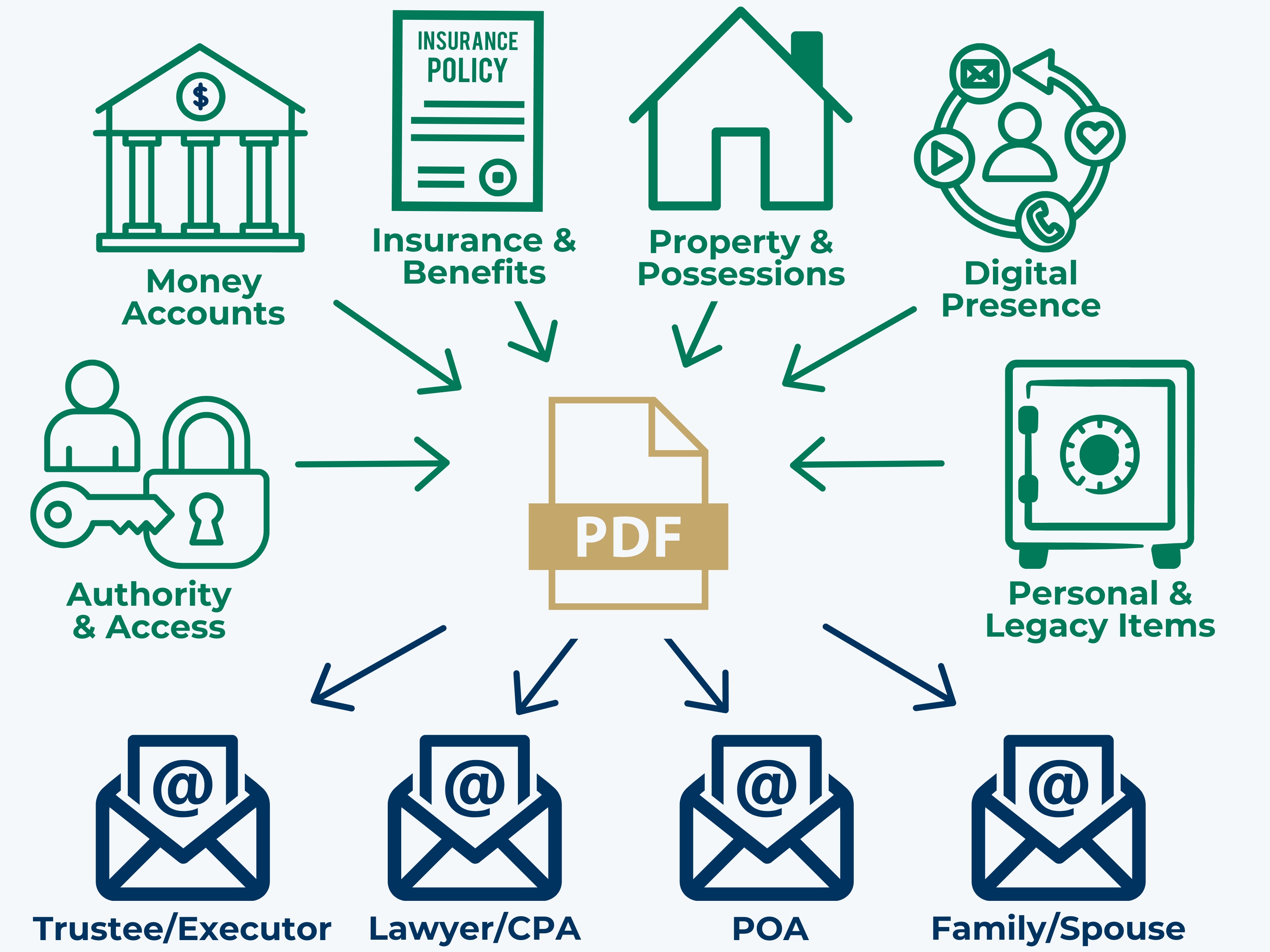
The Legacy Asset Locator ensures the right people have the right information they need to act at the right time - during incapacitation or after death.
How It Works
1. Guided Intake Setup
Answer simple guided questions across six logical categories to comprehensively build your map of what you own, and where it lives.
2. Smart Structuring
These categorized answers are formatted into an easy-to-read, secure, non-sensitive “Legacy Asset Locator.” PDF
3. Quarterly Nudges
You’ll receive email prompts to update anything that’s changed. Updates take five minutes and keeps your asset list living, not forgotten.
4. Secure Distribution
The read-only PDF is shared (per your rules) with your executor, lawyer, CPA, POA, or trusted contact(s) - version-controlled and time-stamped.
Your asset locator simply updates with your life.
Start here.
This is not the full Legacy Asset Locator.
🛡️Security & Privacy Standards
Your map holds where things are, not the keys to them.
What we never ask for or store
Passwords, PINs or security answers
Full account or Social Security numbers (last 4 digits only)
Copies of legal or medical documents
What your map does hold
What exists, and who it’s with
Where documents and logins are kept
Who to contact, and who you’ve appointed
How it’s protected
Encrypted: AES-256 when stored, TLS in transit
Private by default: the database itself blocks anyone else from seeing your map
You choose who sees it: read-only, email-verified, removable any time
Trusted infrastructure: Supabase on Amazon Web Services (US), SOC 2 Type 2 audited
Never sold or shared: no advertising, no tracking inside the app
Security and Privacy by design.
Most Families Don't Have a Hand-off Map
Most families don’t have a map — they have a person. One “operator” who knows which accounts exist, where the documents are, what’s on autopay, and how to get into everything when something breaks.
It works… right up until that person is unavailable.
It’s not anyone’s fault. It’s just how life happens — until you decide to fix it.
Will Vs Legacy Asset Locator
A Will Defines Intent. The Legacy Asset Locator Enables Action.
Accounts, Policies, Wallets, Domains, and Documents live in 20 different places.
Scraps of paper, folders under beds, multiple apps, inboxes, and files - all under different logins, buried in different systems.
If you don't create a centralized record:
Policies get missed. Fees keep charging. Assets get lost.
Every year, millions in “unclaimed” money piles up
The First Page Someone Would Open in an Emergency - Authority & Access
Before listing assets, accounts, and policies, the Legacy Asset Locator creates an Authority & Access map that can be used during incapacity AND after death
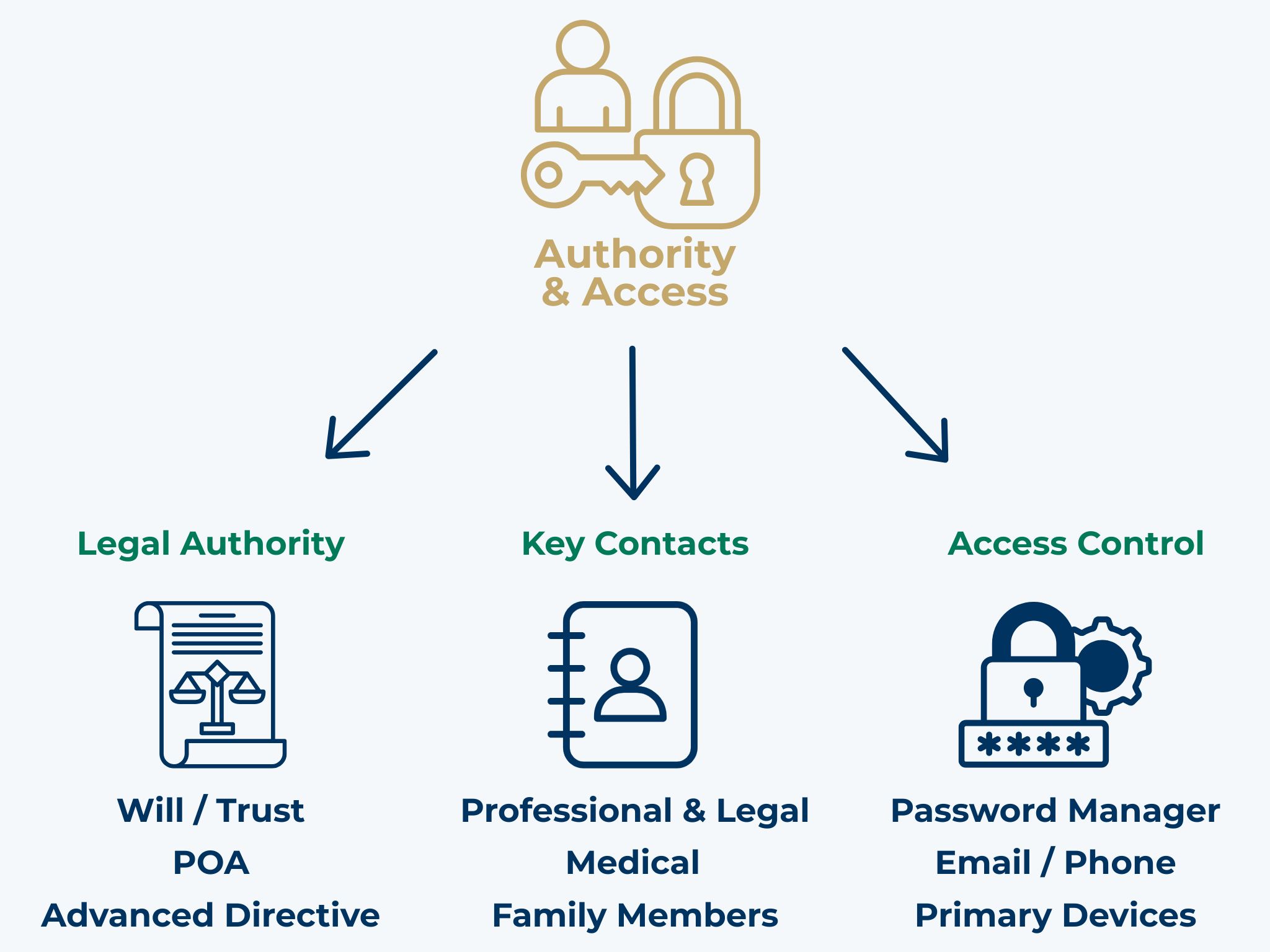
The Legacy Asset Locator gives anyone you authorize a clear, current map of what exists and where to look.
Start with Authority & Access — it's free, takes under an hour, and is the most critical information in a crisis.
Start here. This is not the full Legacy Asset Locator.
What Executors and POAs Are Expected to Find — But Usually Can’t
Most people focus on the obvious assets and miss dozens of smaller ones that still require action.
1. Authority & Access
What authority acts on you life and how it is accessed.
Legal Authority
Key Contacts
Digital Access & Device Control
2. Money Accounts
Everything that moves money in or out of your life.
Banks & savings accounts
Retirement & investment accounts
Credit cards & lines of credit
Payment apps & stored balances
Crypto wallets and exchanges
3. Insurance & Benefits
Lost assets if your family doesn't know about them.
Life & disability insurance
Health & long-term care insurance
Employer benefits
Pensions & survivors' benefits
4. Property & Possessions
The physical world you leave behind.
Real estate & deeds
Vehicles & titles
Safe deposit boxes
Storage units
Firearms & licenses
Valuables & collectibles
5. Digital Presence
Accounts you use and recurring payments
Email, cloud storage, photo libraries
Social accounts & digital legacy settings
Personal subscriptions & memberships
Business subscriptions & services
Rewards & loyalty accounts
Domain names & website hosting
6. Personal & Legacy Items
The important things only you know about.
Personal wishes & instructions
Photos & digital media
Family documents
Memorial preferences
Sentimental items to pass down
Why The Scavenger Hunt Makes Probate Slow, Stressful, and Expensive
Probate courts don’t tell you what exists - your executor has to find out.
Fast Vs Slow Probate
And here’s what almost no one realizes: Assets with a named beneficiary skip probate entirely - saving months of delays and thousands in fees.
The Legacy Asset Locator helps you by prompting if you have beneficiaries designated: If you're unsure or don't know, it creates a 'To Do List' for you so you can address the unknowns.
You can’t avoid probate - but you can avoid expensive probate.
Organization today = massive time and money saved for your family later.
The good news: this is a one-time problem with a one-time solution.
An hour of clarity today means the people you love won't spend months searching tomorrow.

Built by someone who lived this problem
I'm Steve Walker — engineer, husband, dad, and the person in our house who knows where everything is. I spent 20 years in defense and aerospace where documentation wasn't optional.
I built the Legacy Asset Locator after realizing my wife Nicki had no idea how to access our accounts, documents, or policies if something happened to me. We looked organized. We had a will. But what we really had was an invisible mess.
The Legacy Asset Locator fixes that.

Steve and Nicki, McCall, Idaho
Simple, Transparent Pricing
Start free with Authority & Access. Upgrade when you want the full Locator.
No subscription. No renewal. No risk of lapsing right when your family needs it most. Pay once — it's there for life.
Authority & Access - Free
Best for: Best for: getting the essentials in place today.
Includes: your legal documents, key contacts and account access + share with the people you’ve appointed.
Individual Plan - $79
Best for: Anyone who wants their people to find everything.
Includes: All 6 sections + printable PDF + share with the people you’ve appointed + unlimited updates. No subscription.
Not sure? Try it risk-free. If the Legacy Asset Locator isn't right for you, contact us within 15 days of purchase for a full refund — no questions asked.
🛡️Trust & Safety
Encrypted (AES-256 stored, TLS in transit) and private by default
No passwords, PINs or full account numbers. Ever.
Download a PDF copy whenever you want one
You choose who sees your map, and can remove them any time
FAQs
Eight questions. Honest answers. Everything you need before you start.
Is this a will or a legal document?
The Legacy Asset Locator is not a legal document and doesn't replace a will, trust, or power of attorney.
Think of it as the companion to those documents — the practical map that tells the people you've appointed what exists, where it is, and what to do with the authority they've been given. A will says who gets everything. The Legacy Asset Locator helps them find it.
Who is this for?
Anyone who has people they trust and things they'd need those people to find. That's most adults with accounts, property, or a digital life — whether or not they've done formal estate planning yet.
It's especially useful if you've already created a will, trust, or power of attorney. Those documents give people authority. The Legacy Asset Locator gives them the information to use it.
Does it work if I become incapacitated, not just when I die?
Yes — and this is where it's often most valuable.
If you have a stroke, serious accident, or sudden illness, your Power of Attorney may need to act immediately. The Legacy Asset Locator gives them a clear picture of your accounts, documents, contacts, and responsibilities — so they can step in without searching blindly at the worst possible time.
Do you store my passwords or financial credentials?
No. The Legacy Asset Locator never stores passwords, login credentials, banking details, identity numbers, or legal documents.
It's designed to provide clarity and direction — not access. It tells the right people what exists and where to look, so they can use official channels to act with the authority they already have.
What does it actually include?
The full Legacy Asset Locator covers six categories: Authority & Access (your key documents and who holds them), Money Accounts, Insurance & Benefits, Property & Possessions, Digital Presence, and Personal & Legacy Items.
The free tier covers Category 1 — Authority & Access — which is often the most time-sensitive information in a crisis. Individual and Family plans unlock all six categories with unlimited updates.
Is this a one-time purchase?
Yes. No subscriptions, no recurring charges.
The Individual plan is $79 and covers one person, with unlimited updates and sharing with up to five people. The Family plan is $149 and covers two people, with sharing with up to ten people.
How long does it take to complete?
Most people complete a category in 30 to 45 minutes, working through it at their own pace. You don't need to finish everything at once — start with Category 1 and build from there.
The information you put in today is the information that protects your family tomorrow.
Can I update it if things change?
Yes — and you should. Accounts change, assets get added or closed, roles shift, new devices appear.
The value of the Legacy Asset Locator comes from keeping the right people informed over time, not from completing it once and filing it away. You control what's in it and who receives it, at all times.
Is my information safe?
Your map never holds passwords, PINs or full account numbers. It holds where things are, not the keys to them. Everything is encrypted when it’s stored and while it travels, and only you can see your map. The people you appoint can view it, read-only, after confirming their email address, and you can remove them at any time. The app is built on Supabase, which is independently audited to the SOC 2 Type 2 standard.
Still Have Questions
If you have questions that aren't answered above, please feel free to reach out to us at the email address below.
Contact Us:
Disclaimer:
We do not store passwords or sensitive financial credentials. Nothing on this site constitutes legal, financial, or estate-planning advice.
© 2026 Done Once Lab. Legacy Asset Locator is a product of Done Once Lab. All rights reserved.